
Introduction
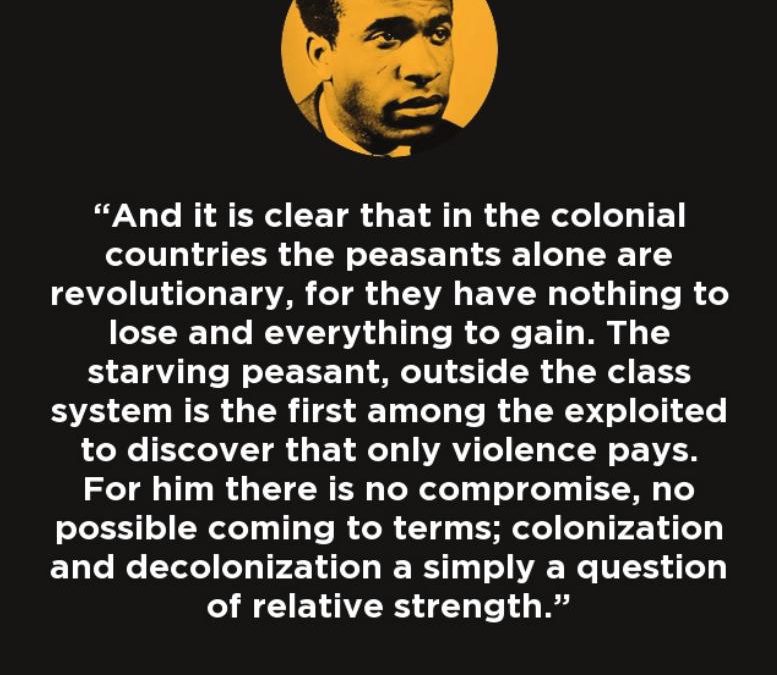
Frantz Fanon’s work has profoundly influenced anticolonial thought across the Global South and continues to resonate within contemporary struggles for liberation as they evolve. Yet, both in academic discourse and within certain progressive circles, Fanon’s legacy is increasingly subjected to misinterpretation and selective appropriation.
As Okoth (2020) argues in his critique of Afropessimism, “the blatant (mis)use of Fanon is a particularly infuriating example of how the AP™ distorts anti-colonial thought. By selectively reading parts of his early work (Black Skin, White Masks) and disregarding pretty much everything else, AP™ scholars try to incorporate Fanon into the genealogy of their misguided attempt at creating a radical Black discourse. Since Black Skin, White Masks (1967) makes for a more comfortable read than The Wretched of the Earth or A Dying Colonialism, the more important Fanon texts for the liberation movements on the continent, this results in a sterilised version of Fanon divorced from revolutionary praxis.”
Okoth further, says – “AP™ has reached for the young Fanon, and tried to isolate him from the rest of his oeuvre. As Wilderson himself contends: ‘Frantz Fanon’s The Wretched of the Earth […] does not build upon Fanon’s Black Skin, White Masks’. While the AP™ is correct in pointing out that there is a difference in approach between Fanon’s early and later work, this does not mean that we should prioritise the former over the latter. Nor does it mean that Fanon’s early work is necessarily based on the assumption of an ontologically flat conception of Blackness. In the introduction to Black Skin, White Masks Fanon concedes that:
‘Since I was born in the Antilles, my observations and my conclusions are valid only for the Antilles – at least concerning the black man at home. Another book could be dedicated to explaining the differences that separate the Negro of the Antilles from the Negro of Africa.’
The appropriation of Fanon by some African-American scholars and activists who reduce his thought to a hashtag, and make proclamations that Fanon himself would have fundamentally disagreed with also begs the question of why only Fanon, singled out and isolated from all other anti-colonial thought, has been granted a cushy place in the Ivory Tower. Why is there still very little scholarship on Black revolutionaries such as Amílcar Cabral, one of the foremost anti-colonial theorists and revolutionaries of the twentieth century?
This kind of selective reading by different sections of liberals whether Afropessimists or whatever has led to a fragmentation of Fanon’s political thought, divorcing his radical critique of neocolonialism and imperialism from the broader revolutionary tradition of which he was an integral part. A renewed, holistic engagement with Fanon is essential for rethinking and revitalising Pan-Africanism today and importantly in the continent of Africa.
Contemporary African geopolitics, particularly the growing rejection of Western domination by states in the Sahel, shows a major rupture with the post-Cold War neoliberal consensus. These states, are forging new regional alliances and expelling neocolonial powers, gesturing toward what some have termed a renewed call for African liberation. Their defiant stances coincide with a global shift toward multipolarity, characterized by the challenging dominance of US-led unipolar hegemony and the rise of new geopolitical actors, including China, Russia, and the BRICS+ nations. The BRICS alliance is not an ideological bloc like the Soviet Union, but its members are united by common issues that still offer an alternative to unipolar dominance.
In this emerging context, Pan-Africanism is once again being redefined not just as an aspirational ideal of continental unity but as a concrete political project rooted in sovereignty and anti-imperialism so far. Biographers such as David Macey, Leo Zeilig, and Nigel Gibson provide evidence that Fanon’s support for armed struggle was inseparable from his Pan- African vision. He travelled widely in Africa during his service with the FLN, working to connect the Algerian war to movements in sub-Saharan Africa, including the Congo and West Africa. Gibson (2011) notes that Fanon consistently argued that the liberation of Algeria was not only an Algerian project but “a node in a continental chain of revolutions” (p. xx). Fanon, is still widely read in today’s world as he was read in the last century.
As Ngũgĩ wa Thiong’o said in Writing Against Neocolonialism (1986, p8), “I have always argued that literature written by Africans, and particularly the literature of this period, cannot really be understood without a proper and thorough reading of the chapter ‘Pitfalls of National Consciousness’ in Fanon’s The Wretched of the Earth. The literature of this period was really a series of imaginative footnotes to Frantz Fanon.”
And why is it important to see Pan-Africanism as a continuous political project today, using the Sahel as a case study? It is because Pan-Africanism cannot emerge from abstract theory alone and its history is testament to that when it comes to revolutions. And focusing on the Sahel because it is the most recent rupture with French neocolonialism in Africa. As both Fanon and Amílcar Cabral pointed out, there can be no real liberation without the integration of theory with praxis. Thus, contemporary movements and alliances must draw deeply from this foundational insight. Situating Fanon’s ideas within the current revolutionary developments, such as in the Sahel and placing them in dialogue with other African liberation theorists provides an understanding of Pan-Africanism as a living, evolving, and contested project.
Pan-Africanism as a Continuous Project Today
Pan-Africanism has never been just a rhetoric of racial solidarity; it has been a political strategy of anti-imperialist unification aimed at transforming the colonial state and the world economy that sustains it (Adi 2019). From the Manchester Congress (1945) to the All-African Peoples’ Conference (1958), the project linked struggles across the continent and diaspora to a common agenda of sovereignty and change. In this sense, Pan-Africanism is best read/seen as a continuous project, periodically stalled, rerouted, or co-opted but revived whenever conditions permit renewed bids for collective autonomy and struggle.
Fanon belongs in this militant Pan-African genealogy. In The Wretched of the Earth and Toward the African Revolution, he theorised decolonisation as a continental process, showing that national independence without regional change would relapse into dependency (“the pitfalls of national consciousness”). Fanon’s critique of the national bourgeoisie is explicitly a class analysis of how postcolonial intermediaries reproduce imperial domination unless countered by mass organisation and international solidarity (Fanon 2007).
Importantly, Fanon’s practice matched his theory. As an FLN cadre and diplomat, he worked to link the Algerian struggle to sub-Saharan movements, traveling as an emissary, building contacts in West and Central Africa, and arguing that victories like Algeria’s could only be secured through a wider African offensive (Zeilig 2016).
Looking at today’s Sahel rupture through this frame, Fanon helps pose the right questions; Do these breaks disrupt the regional mechanisms of dependency (currency regimes, bases, extractive concessions)? Do they expand popular participation and political education, or centralise power within new elites? Are they building horizontal Pan-African linkages, security, productive capacity, financial autonomy, that convert symbolic sovereignty into enduring sovereignty? The Fanonian yardstick is not the fact of rupture alone, but whether rupture is organised beyond the nation, rooted in the people, and oriented to change the regional conditions that reproduce underdevelopment.
The Post-independence Crisis and Elite Betrayal
The revolutionary promise of Pan-Africanism was rapidly undermined in the aftermath of formal independence during the 1960s. Across the continent, liberation movements that had been led by radical visions of change gave way to elite-led projects of state-building and ‘development’. This is precisely the dilemma that Frantz Fanon warned of in The Wretched of the Earth:
The national bourgeoisie, which takes over power at the end of the colonial regime, is an underdeveloped bourgeoisie… Its mission has nothing to do with transforming the nation; it consists of being the transmission line between the nation and capitalism, rampant though camouflaged, which today puts on the masque of neocolonialism” (Fanon 2007, p. 152).
For Fanon, elite betrayal was very structural. The postcolonial bourgeoisie, lacking an industrial or productive base, could only secure its position by mediating between the former colonial powers and its own population, thereby reproducing dependency. This theme runs through his critique of “the pitfalls of national consciousness”: political independence would be hollow if not grounded in mass participation, socialist transformation and Pan-African unity.
The trajectory of Kwame Nkrumah, for example, shows both the possibilities and pitfalls Fanon identified. Nkrumah’s early call for immediate continental unity, outlined in Africa Must Unite and embodied in the Casablanca bloc, resonated with Fanon’s insistence that liberation could not stop at the nation-state. But, as Fanon predicted, Nkrumah’s own regime became increasingly entangled in contradictions, caught between radical Pan-African aspirations and the class compromises of a national bourgeoisie dependent on foreign aid and investment. After his 1966 overthrow, Nkrumah himself acknowledged this tension in Class Struggle in Africa (1970), conceding that earlier rejections of class analysis had obscured the dangers Fanon had already warned against.
Julius Nyerere’s Arusha Declaration (1967) similarly embodied the promise of building a self-reliant socialism rooted in African communal traditions. But Fanon’s framework highlights its contradictions: by denying the existence of classes in Tanzania, Nyerere underplayed the very dynamics of elite reproduction that Fanon regarded as decisive. Walter Rodney further argued that Ujamaa ultimately became a form of “nonscientific socialism” vulnerable to bureaucratic capture and dependency.
Amílcar Cabral, by contrast, echoed Fanons emphasis on class clarity and ideological struggle. His insistence that African liberation required both national culture and rigorous materialist analysis aligned with Fanons warning that elites would abandon revolutionary tasks unless bound by the discipline of the people. As Cabral declared, Class suicide was the only guarantee against elite betrayal — a formulation that resonates directly with Fanon’s call for a leadership fused with, not above, the masses.
Even where leaders like Senegal’s Senghor or Kenya’s Kenyatta invoked “African socialism,” the tendency was toward dilution and compromise, validating Fanon’s prediction that national elites would mimic the colonial order under the guise of sovereignty. Policies such as Kenya’s 1965 Sessional Paper No. 10 entrenched capitalist dependency under the banner of socialism, a textbook case of the intermediary role Fanon described.
Thus, Fanon’s analysis provides the thread that ties these diverse trajectories together; the postindependence crisis was fundamentally a crisis of class leadership. The new elites, rather than realising the radical promise of Pan-African liberation, became custodians of neocolonial dependency.
This pattern of elite betrayal must also frame any
analysis of contemporary ruptures in the Sahel. While military-led governments in Mali, Burkina Faso, and Niger present themselves as challengers of neocolonial domination. The challenge, then, is whether these breakaways can overcome the very pitfalls Fanon diagnosed, transforming a national rebellion into a Pan-African project rooted in the people.
Pan-Africanism in the Age of NGOs and Soft Power
Thus, the late 20th and early 21st centuries saw the reconfiguration of Pan-Africanism under the shadow of neoliberal hegemony. What once stood as a revolutionary project for continental unity and collective sovereignty has been increasingly co-opted by donordriven initiatives, regional elites, and a burgeoning network of NGOs operating under the rubric of ‘civil society’. Market-oriented schemes such as the African Continental Free Trade Area (AfCFTA) are now promoted as flagship Pan-African achievements. But these initiatives often reproduce, rather than dismantle, the continent’s subservience to global capital. While presented as steps toward economic integration, such policies have typically failed to challenge the structural realities of extractivism, commodity dependency, and unequal exchange that define Africa’s neocolonial condition presently.
Simultaneously, a depoliticised cultural Pan-Africanism has gained prominence, one centered on shared heritage, diasporic connection, and symbolic gestures of unity. Afro-futurist festivals, media celebrations of ‘African excellence’, and state-sponsored commemorations offer a veneer of solidarity that frequently obscures the deeper, material contradictions confronting African realities. Stripped of class analysis and revolutionary content, these forms of cultural unity offer little to those who suffer the brunt of imperialist exploitation, the working poor, the landless peasantry, and the unemployed youth whose futures have been mortgaged by neoliberal reforms. The radical praxis that once defined Pan-Africanism has been replaced by Afro-optimism, a discourse that celebrates inclusion in the global economy without questioning the terms of that inclusion.
Frantz Fanon, in Toward the African Revolution, says that the gravest danger facing Africa was not colonialism itself, which he believed would soon be dismantled, but the “absence of ideology.” Without a coherent ideological compass, the continent was vulnerable to misdirection and counter-revolution. Fanon observed, “Colonialism and its derivatives do not, as a matter of fact, constitute the present enemies of Africa. In a short time, this continent will be liberated… The great danger that threatens Africa is the absence of ideology.” (Fanon, 1964, p. 186). His critique anticipates the contemporary reality, where much of the organised political terrain has been ceded to NGO actors and African elites with no commitment to overturning the capitalist order.
This ideological void has contributed to a disjuncture within popular movements, a gap between those with the courage to resist and those equipped with the theoretical tools necessary to transform resistance into revolutionary rupture. In the absence of sustained political education and ideological clarity, movements have become susceptible to adventurism, populism, and celebrity activism forms of engagement that, while often well-intentioned, ultimately isolate them from the broader masses. Fanon’s warning remains relevant: “Our mistake, the mistake we Africans made, was to have forgotten that the enemy never withdraws sincerely. He never understands. He capitulates, but he does not become converted.”
The Sahelian Break — Towards the African Revolution
Since the 2020s, countries across the Sahel which includes Mali, Burkina Faso and Niger have emerged as epicentres of rupture against the post-independence neocolonial order. Popular uprisings and military takeovers in these nations represent more than episodic ‘coups’, as framed by Western media of what was the norm of the 20th century coups, but rather expressions of deeper crises of legitimacy for Western-backed regimes that have long failed to deliver security, sovereignty, or economic equality. As Walter Rodney noted in How Europe Underdeveloped Africa (1972), “Underdevelopment is a paradox. Many parts of the world that are naturally rich are actually poor, and parts that are not so well off in wealth of soil and sub-soil are enjoying the highest standard of living.”
The capitalist world system, which siphons wealth from the Global South to the metropoles, offers the structural explanation for this paradox fuelled by mass disillusionment with France’s continued military occupation, the collapse of state authority in the face of jihadist insurgencies, and the grinding poverty worsened by decades of structural adjustment and IMF dependency, the peoples of the Sahel have begun to push back. Their resistance reveals an intuitive grasp of Fanon’s imperative: “Each generation must, out of relative obscurity, discover its mission, fulfill it, or betray it.”( Fanon, 2007) The anger erupting across the Sahel targets not only the corrupt national elites, but also the broader architecture of international control manifested in institutions like ECOWAS, the CFA franc system, and French military bases.
As Tri continental’s dossier on The Sahel Seeks Sovereignty stresses, the Alliance of Sahel States (AES), emerged not from elite intrigues but from popular currents of resistance. Unlike the Western-backed coups of the 1960s and 1980s, which toppled liberation leaders to entrench dependency, these ruptures were propelled by grassroots mobilisation, mass protests against the CFA franc, and direct confrontations with French military convoys.
Military-led governments in Burkina Faso (under Captain Ibrahim Traoré), Mali (Colonel Assimi Goïta), and Niger (General Abdourahamane Tchiani) have responded to these popular currents by forming the Alliance of Sahel States (AES) in September 2023. This regional bloc signifies a security pact and it is also part of a political realignment that openly rejects French hegemony, neoliberal austerity, and the externally imposed norms of liberal democracy.
The evolution of events was clear. As the French military presence deepened under the pretext of ‘counter-insurgency’, civilian casualties mounted and security deteriorated. Public anger swelled across the region. In Mali, mass protests culminated in two military coups (2020 and 2021), eventually installing Colonel Goïta’s transitional government. In Burkina Faso, a wave of anti-French sentiment triggered a coup in January 2022, followed by a second coup later that year led by Captain Traoré, propelled by the government’s failure to tackle escalating insecurity. Mali terminated its defence accords with France in 2022, prompting French troops to withdraw. Following closely, in January 2023, Burkina Faso demanded the expulsion of French military forces from its territory. (Peoples Dispatch, 2023).
We are not able to predict the full outcome of the unfolding struggle in the Sahel. But what is already evident, however, is that it has re-opened a space for thinking about revolutionary change on the continent. For decades, Africa has lived under the heavy weight of unfulfilled promises of independence where political liberation did not translate into economic freedom or popular sovereignty. The Sahel moment, with all its challenges, has reopened a conversation long silenced by the dominance of neoliberal governance, Westernbacked regimes, and elite-driven politics.
Historically, progressives and left forces have been wary of military coups and for good reason. The 20th century gave us more than enough examples of dictatorships that emerged from coups, derailed revolutionary momentum, suppressed people’s movements, and entrenched neo-colonialism through violent statecraft. From Mobutu in Congo to Idi Amin in Uganda, many military takeovers led to regimes that were worse than the civilian governments they replaced.
But the situation in the Sahel demands a deeper, more dialectical analysis. These recent coups have not simply been power grabs by self-interested generals. Rather, they have emerged from the ashes of popular discontent. In some cases, these regimes have openly denounced France’s neo-colonial grip, shut down exploitative mining contracts, and sought alternative geopolitical alliances.
This challenges us to reconsider a key principle; the revolutionary struggle is always about capturing political power. And this is a terrain that the left in Africa has largely lost over the last half-century. While we’ve organised from below, educated, resisted, and dreamed, we have often failed to pose a credible force to take power.
It is not to say we romanticise or uncritically support military governments. But we must also resist liberal moralism that rejects any rupture with imperialism simply because it does not fit into textbook definitions of democracy. The bottom line is this, in an age of recolonisation through debt, militarism, and extractivism, we must welcome every effort that defends sovereignty, confronts imperialism, and opens space for people’s power to grow.
This position resonates with Fanon’s own politics in the early 1960s. In his work with the Algerian FLN, Fanon insisted that liberation could not be reduced to the adoption of European-style parliamentary democracy, since such forms often served to mask neocolonial domination. For him, the legitimacy of a political rupture lay not in its conformity to liberal norms but in its capacity to dismantle imperial control and empower the masses. As he wrote: “The liberation struggle does not give itself the luxury of choosing its terrain; it has to engage imperialism wherever it is found” (Fanon, 2007, p. 86). He was acutely aware that, in conditions of armed struggle, the forms of politics would often be unconventional, even militarised. What mattered was not whether liberation conformed to European models of governance, but whether it created the possibility of ‘new humanism’ rooted in the people’s active participation.
The Sahel has reminded the continent and indeed the world that imperialism is not invincible. The question is, what will we do with this reminder?
Thats why Frantz Fanon’s vision offers a profound lens through which to interpret the rebellions unfolding across the Sahel. His call for a total rupture with colonial structures, for the active participation of the people in building the nation, and for resistance — armed when necessary — finds unmistakable echoes in the ongoing political realignments in Mali, Burkina Faso and Niger. Again, Fanon warned, with clarity, that the post-colonial bourgeoisie would not liberate Africa; rather, they would entrench dependency, becoming intermediaries of imperial domination. In the formation of the Alliance of Sahel States (AES), we witness an emerging challenge to this model not flawless, not without contradictions, but resonant with the aspiration for genuine sovereignty.
“There is a straight line that runs from the formation of this Confederation to the pan-African sentiments that shaped the anti-colonial movements in the Sahel over 60 years ago.”
The current wave of resistance has grown from frustration with decades of neocolonial interference, particularly from France. The legacy includes the fallout of NATO’s destruction of Libya in 2011, creating fertile ground for jihadist insurgencies; the failure of French military interventions to bring security; and the economic stranglehold maintained through the CFA franc and control over financial transactions. Further aggravating this discontent is the way France and the EU have weaponised anti-terrorism discourse to construct anti-migration barriers serving Europe’s interests while Africa pays the price. (Peoples Dispatch, 2024)
In this context, the AES has taken bold steps, announcing a regional passport, unveiling a new flag, and pushing toward deeper integration. The leadership is filled with Pan-African themes, sovereignty, and cultural renaissance. References to Thomas Sankara and Kwame Nkrumah have returned to the public imagination, and the popular rejection of the CFA franc, a symbol of French monetary colonialism, has intensified. These governments are also pivoting geopolitically, seeking alternatives to Western domination through new partnerships with Russia, China, and BRICS+ actors, signalling a partial reorientation toward a multipolar global order.
Again, as mentioned the BRICS nation is not necessarily an ideological bloc fond of the Soviet Union but is held with shared interests and issues. It has expanded to include new members, presents itself as a platform for a more equitable global order, and its appeal has grown in Africa.
China’s Belt and Road Initiative (BRI), has offered large-scale infrastructure financing on terms that Western donors have consistently withheld. Russia’s reengagement in Africa, driven by security partnerships, military training, and anti-imperialist posturing, has gained traction, particularly in Sahelian and Central African states, rejecting French neocolonial military presence. Meanwhile, India and Turkey have expanded trade, cultural ties, and strategic investments across the continent. This shift has opened a limited but notable diplomatic and economic breathing space, allowing African states to negotiate with greater leverage, at least in theory as Western dominance persists.
Multipolarity, for all its challenges and nuances, has opened a strategic window to reimagine Pan-Africanism in concrete and practical terms. The return of political non-alignment, the pursuit of currency and financial sovereignty, the formation of regional defense pacts, and the push for continental industrialization could be tangible possibilities. As Fanon reminds us, “During the colonial period the people are called upon to fight against oppression; after national liberation, they are called upon to fight against poverty, illiteracy and underdevelopment. The struggle, they say, goes on. The people realize that life is an unending contest” (Fanon 2007).
This is the challenge and the opportunity of the current moment in the Sahel. As the world looks on, it is not the AES’s break with France alone that must be evaluated, but whether it can complete genuine liberation, which requires not only a radical political agenda but also the active participation of the masses and thus a total break away with Neocolonialism structures as Frantz Fanon advocated. It is now 100 years since the birth of Frantz Fanon. A century on, his warning that colonialism and its local collaborators would persist in new guises remains a relevant rallying call.
Reference
Books
Adi, H. (2019). Pan-Africanism: A history. Bloomsbury Academic.
Cabral, A. (1969). Revolution in Guinea: Selected texts. Monthly Review Press.
Fanon, F. (1967). Toward the African revolution (H. Chevalier, Trans.). Grove Press.
Fanon, F. (2007). The wretched of the earth (R. Philcox, Trans.). Grove Press.
Ngũgĩ wa Thiong’o. (1986). Writing against neocolonialism. Writers and Readers Publishing Cooperative.
Nkrumah, K. (1964). Consciencism: Philosophy and ideology for de-colonization. Monthly Review Press.
Nkrumah, K. (1970). Class struggle in Africa. International Publishers.
Nyerere, J. (1967). The Arusha Declaration and TANU’s policy on socialism and self-reliance. Government Printer.
Rodney, W. (1972). How Europe underdeveloped Africa. Bogle-L’Ouverture Publications.
Book Chapters
Cabral, A. (1964). Brief analysis of the social structure in Guinea.
Lenin, V. (1920). Theses on the national and colonial questions. In 2nd Congress of the Communist International.
Online Articles
Mwangi, N. (2023, December 7). Populist trends or revolutionary Pan-Africanism? Hood Communist. https://hoodcommunist.org/2023/11/30/populist-trends-or-revolutionary-pan-africanism/
Okoth, K. O. (2020, January 16). The flatness of Blackness: Afro-pessimism and the erasure of anti-colonial thought. Salvage. https://salvage.zone/the-flatness-of-blackness-afro-pessimism-and-the-erasure-of-anti-colonial-thought/
Prashad, V. (2024, July 8). The Sahel stands up and the world must pay attention. Peoples Dispatch. https://peoplesdispatch.org/2024/07/08/the-sahel-stands-up-and-the-world-must-pay-attention/
Singh, T. (2023, September 18). Burkina Faso, Mali, and Niger form Alliance of Sahel States to advance collective defense. Peoples Dispatch. https://peoplesdispatch.org/2023/09/18/burkina-faso-mali-and-niger-form-alliance-of-sahel-states-to-advance-collective-defense
