
Kenya has practised capitalism from the time the European imperialists ventured into this territory. The foreigners were warmly welcomed as it is the culture of Africans. All the same, the said foreigners disrespected this welcome and conquered territory — although with s tiff resistance from the indigenous people. One thing that needs to be noted is that before the encounter with the foreigners, all nationalities in Africa lived freely with a great abundance of resources at their disposal. Hardly could one hear cases of hunger, and the established rules and cultural norms were all respected and rarely not adhered to.
Internationally, improvement of productive forces and the evolution of the modes of production facilitated the emergence of imperialism (the highest stage of capitalism). As imperialism entails conquering the weaker states and stealing their resources to maximise profit, countries in Europe embarked on this mission through which they used violence and religious indoctrination to subdue the people and acquire their territories in Africa, Latin America and Asia. In the case of Africa, a conference was held between 1884-1885 to strategise on how the imperialists could divide the continent among themselves. That is how Kenya became a British protectorate.
Their greed could not allow them to share the loot in peace and in 1914, the First World War started, which involved the various imperialist forces such as Britain, France, Germany, Italy, Japan, USA etc. who were competing to capture new markets, new areas for financial capital and raw materials for their industry from the various colonies. Workers and peasants of the affected countries were brainwashed into supporting phony nationalism. Many of them were recruited and joined armies where they fought for their respective imperialist countries. The war catalysed a capitalist crisis and gave impetus to Russian workers to revolt against their oppressive government, which had sided with imperialists to rob them of their wealth and exploit them. Under the leadership of Lenin, workers overthrew the government and installed a new one that unchained the fetters of oppression and exploitation. The new government ended the first “world” war. During the First World War, Lenin and his Bolshevik party campaigned against it and were preaching internationalism among all workers and peasants in the world whom they aspired to mobilise against imperialism. After a concrete analysis based on objective conditions, the Bolsheviks negotiated with Germany and a compromise was reached in which Russia gave out part of its territory.
The Russian revolution changed the international political and economic arena as the country rose from the status of being underdeveloped to developed, surpassing some of the imperialist countries in terms of industrial production. On the other hand, the capitalist countries continued to face one crisis after another though they used a pragmatist style to postpone the crisis. In the early 1930s, a major crisis, the Great Depression, swept through the capitalist countries but did not touch Russia. This crisis took the intervention of a bourgeois economist by the name John Maynard Keynes to mitigate. Keynes borrowed ideas from socialism and mixed them with capitalism to resuscitate the fallen economies of the capitalist countries, and in this way succeeded in stimulating demand in the economy by distributing income to the lower classes (poor). His ideas entailed giving government power to control the economy through nationalisation of some basic industries and imposing higher taxes for higher social spending. These ideas, which were named after him, and are referred to as Keynesian economics, diminished the effects of the crisis but failed to end the string of capitalist crises. This is because crisis in capitalist states, as argued by Karl Marx, is not a result of the scarcity of goods but due to overproduction. This overproduction is not needed by people but is a surplus of what can be sold at a profit.1 No wonder food is destroyed while people starve because they have no money to buy it; similarly, the majority of people are homeless while many houses remain unoccupied. Though the intervention of Keynes temporarily stabilised capitalism, a group of bourgeois economists associated with the Chicago School of Economics, led by Milton Friedman and George Stigler, advanced a contrary position. They argued that capitalism could prosper by adhering to the principles of a free market, monetarism, deregulation and privatisation. Their ideas however became popular in 1970s, as we shall see later.
In USA, President Franklin D Roosevelt (1933-1938) coined a New Deal, which was about economic, social and political reforms geared to overcome the crisis. The New Deal stabilised the economy but, according to Richard Wolff, a Marxian economist, it was not simply a generous reform created by a visionary president but the result of mass pressure from below, a crisis of capitalism, and a political bargain between workers and business elites.2 In short, the New Deal was meant to save capitalism from collapsing and preventing a socialist revolution, which at the time seemed like a real possibility especially given the rise of labour militancy and the global influence of the Soviet Union.
After the Second World War period, according to Richard Wolff, the US economy emerged intact and in a better state than when it entered while the industrial capacities of Britain, France, Germany, Italy, Japan and Russia were largely destroyed. This allowed the US to dominate the global market without significant rivals. Since the USA was not affected by the war in terms of destruction, it initiated a Marshall Plan aimed at reviving industries, building infrastructure, while stopping the spread of socialism. A total of about $13 billion were given to 16 countries in West Europe.
In the UK, reforms were also initiated to preserve capitalism though they were resisted by Conservatives. For example, in 1943 the Conservative MP Quintin Hogg warned his fellow MPs who were seeking to block meaningful discussion about the formation of a post-war welfare state, that if they were not to give the people social reform, they would bring social revolution.3 The reforms witnessed the building of thousands of council houses (affordable houses for lowincome earners) and the establishment of comprehensive education (free) for the first time, thus giving low income or poor children the opportunity at higher education. In regard to health, the National Health Service (NHS) was created in 1948 to provide free universal health to all citizens.
The post-war economic boom or the Golden Age of Capitalism came to an end in the early 1970s. This decline stemmed from capitalism’s internal contradictions, which were intensified by several external shocks. These included the 1973 oil embargo imposed by OPEC on countries supporting Israel during the Yom Kippur War, an event that caused oil prices to quadruple4 and the collapse of the US dollar’s convertibility into gold. These developments contributed to a broader economic crisis across Europe.
According to David Harvey, a key factor behind the crisis was the rising power of labour relative to capital, with strong trade unions exerting significant bargaining influence. The results were declining profit rates for capitalists, rising unemployment, higher inflation, and a decline in living standards. In response, capitalist governments increasingly turned to ideas associated with the Chicago School of Economics, implementing restructuring measures aimed ultimately at restoring the class power of capital.
In the late 1970s and early 1980s, Margaret Thatcher and Ronald Reagan were elected as prime minister and president of Britain and the USA (two of the most powerful imperialist countries), respectively. They embarked on implementing neo-liberal policies such as privatising public institutions and services, weakening labour laws and collective bargaining, thus widening the gap between the rich and the poor. By 1985, the excessive amount of labour, in contrast to capital, had been resolved only to be replaced by another problem of excessive power of finance capital due to a stagnation of wages since the 1970s. The stagnation of wages helped the capitalists to increase their surplus.
Since wages are used to buy consumer goods, the demand for goods went down during this period. This then made the capitalists introduce debit and credit cards meant to help workers buy things, sometimes even basic necessities on credit. Since capitalism entails getting profit, the imperialists exported part of the excessive financial capital to states where labour power was being paid less, e.g. Asia, Africa and Latin America in order to get more return on their investments by paying lower wages. The capital also came as loans to some of the production industries in global South countries. Since capitalists were desperately trying to get rid of their surplus capital, their interest rates were very low as compared to interests charged by financial institutions in Asian countries. This resulted in overinvestment and overproduction, particularly of electrical goods and motor industries, triggering a crisis in Asia in 1997/8. Countries such as Thailand, Malaysia, Indonesia and the Philippines tried to mitigate the situation by devaluing their local currencies but this only worsened the crisis. Fearing that their financial institutions were poised to lose their capital, the Western imperialists forced the International Momentary Fund (IMF) to rescue the so-called Asian countries by giving them loans that cumulatively came to more than $100 billion. The loans were tagged with some hazardous conditions (Structural Adjustment Programmes — SAPs) such as divestiture from social welfare spending so that they could pay their foreign debt, which included the loans from the IMF rescue package.5
It should be understood that one of the factors that had contributed to the rapid growth of Asian countries’ GDP was their practice of state capitalism; they protected their companies from foreign competition and this is one of the things the IMF wanted to stop. In summary, the IMF conditions did not help the people since about 10 million people lost their jobs, while about 50 million people in Asia alone fell below the poverty line.
Since international capitalism is intertwined with banks, the Asian crisis affected other imperialist countries, particularly the USA, which had used surplus value from Asia to reinvest in its own country and particularly in mortgages and low interest loans. The decade of the 2000s witnessed speculation, where bonds and shares of various companies were hyped to attract potential buyers. The competition among various financial institutions, especially those specialising in mortgages, introduced subprime mortgages, where they gave loans to borrowers who would not qualify for a prime mortgage because of their poor incomes, or who had a bad credit history.
The majority of blacks and Latinos, who are victims of USA imperialism, ran to the mortgages. Since capitalism aims to attain maximum profit through speculation, the economic bubble burst, resulting in one of the greatest capitalist crises since 1930. Many big companies specialising in banking and mortgages, which few believed would one day go bankrupt, went down one after the other. The first to go down were Lehman Brothers, Citigroup Inc multinational banks, mortgage lending companies Fannie Mae and Freddie Mac, and American International Group (AIG) Insurance Company, which had secured loans for other banks and mortgage companies through a policy called Credit Default Swaps (CDS). AIG was to pay the banks in case the banks defaulted, but it failed to achieve this since it had no solid capital after it underwrote huge amounts of CDS on mortgage-backed securities. It took the intervention of the federal government to come up with a formula for rescuing the companies. Then, the government used US taxpayers’ money, most of whom the same companies had exploited.
The scenario was taunted as socialism for the rich as billions of dollars were used in this exercise. For example, $85 billion was used to bail out AIG.6 It’s ironic that millions of USA citizens experience hardship in getting medical care due to a lack of insurance cover and yet the federal government assists the owners of capital who are the source of their miseries. The state sugarcoats the argument that failing to bail these multinationals out will result in an increase in unemployment, which would worsen the economic situation. This hoodwinks the poor and makes them ignorant as to their real predicament and conditions them to be passive about challenging the unfair system.
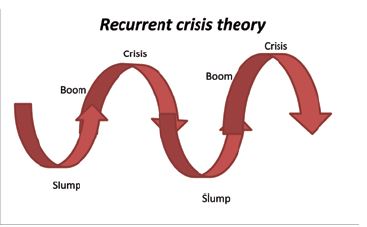
The above analysis clearly shows that economic crisis in capitalist states is endemic to the system and there is no way it can be solved without getting rid of it entirely. Through his writings, Marx has scientifically argued that capitalism cannot develop or expand without interruption as it is involved in cycles of booms and bursts. During the boom, many commodities are produced and in the beginning, huge profit is made. Nevertheless, as time goes by, the demand for commodities goes down thus reducing profit, which is the engine of the whole process, and therefore triggering a crisis. Therefore, one would ask: how can this recurring crisis, which results in massive unemployment and a compromising of social welfare, be put to an end? The answer lies in forming a vanguard party, which will uproot the capitalist system that creates these regular crises.
The importance of a vanguard party which can unite all the forces against capitalism is very important in the present time when people are ruled by state-backed corporations. The party, if led by ideologically sound cadres, can show the path to the elimination of exploitation of a human by a human; a dog-eat-dog society, which is the predominant model in Kenya and other capitalists states. The party will show the alternative to production where planning is prioritised in order to avoid unnecessary wastage, and the needs of the people are met. The propaganda channeled by the bourgeois and their media, that there is no alternative to the current market system, will be easily countered by such a party. The vanguard party will be guided by a high level of discipline and commitment among its members and the principle of democratic centralism will be practised. The party would have a single central leadership, lower cadres to be subordinate to higher cadres, minorities subordinate to majority and individual interests should be subordinated to those of the party. This would occur at the same time as ensuring that the democratic involvement of all members is maintaned.
The ultimate goal of such party will be to overthrow the capitalist state and usher in a national democratic state, which will make sure that the sweat of workers is properly rewarded. The state will then transit to socialism where people will be rewarded according to the work they do under a principal of “from each according to his ability, to each according to their work”. All the parasites that feed on other people’s sweat by exploiting them will be crushed. A culture of solidarity among all the people of different races, sexes, and religions will be fostered. Economic structures, social relations and ideas that perpetuate social and class
division will be consciously transformed. The masses will be empowered and will dictate how things will be run to serve humanity. Another type of democracy (working class), which entails serving the majority, particularly those who were formerly oppressed under capitalism, will rule the state and the means of production will be under the control of the people.
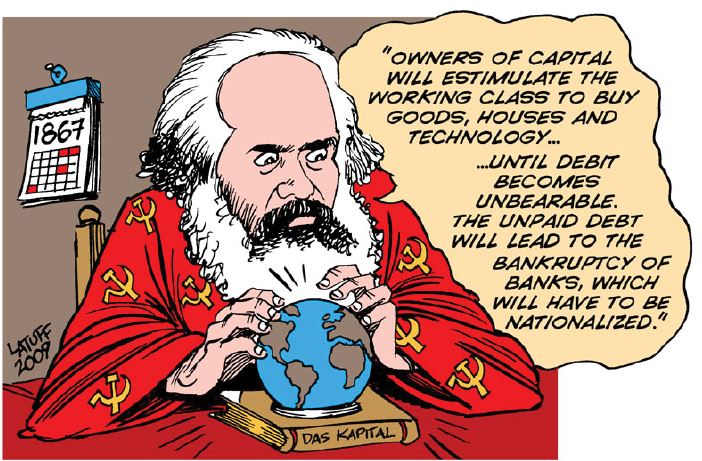
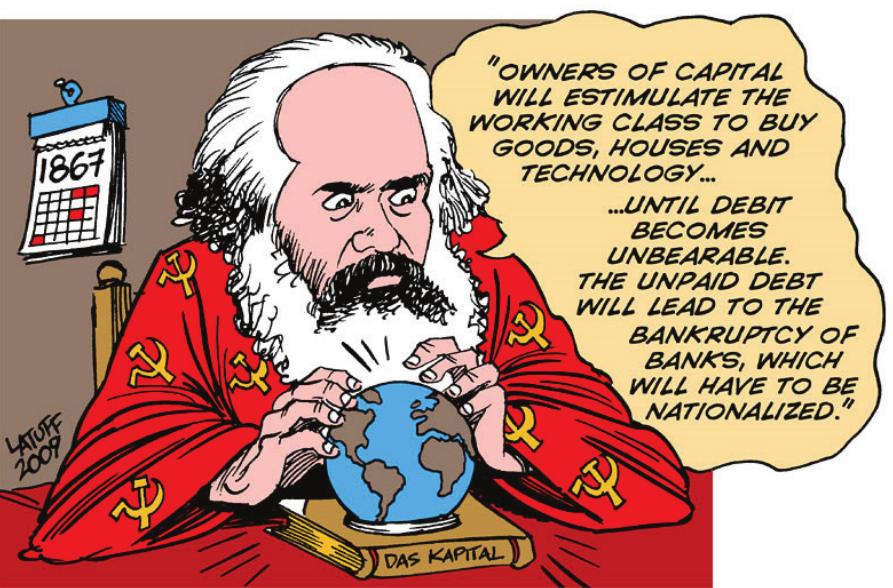
Owners of capital will stimulate the working class to buy more and more of expensive goods, houses and technology, pushing them to take more and more expensive credits, until their debt becomes unbearable. The unpaid debt will lead to bankruptcy of banks, which will have to be nationalised, and the State will have to take the road which will eventually lead to communism.
