The current issue of The Kenya Socialist is being published at a time when capitalist crises both locally and globally are intensifying. These crises are not accidental but are rooted in the structural contradictions of capitalism itself manifested through intensified exploitation, inequality and the subordination of social needs in the pursuit of profit. In Kenya, the government has failed dismally providing essential services to its citizens, instead prioritising imperialist interests through the privatisation of national institutions. This is evident in the ongoing privatisation of key public institutions like Kenya Petroleum Company (KPC), which facilitates the transfer of public wealth into private hands. As a result, critical sectors are in crisis, and the majority of Kenyans are unable to meet their most basic needs.
For instance, the Social Health Authority (SHA), which was presented as a vehicle for accessible healthcare, has instead deepened hardship, pushing many families further into poverty. Similarly, in education, thousands of students remain at home due to lack of fees1, despite the government’s 2024 commitment to ensure inclusive, accessible, and affordable education for all2. These failures have provided fodder for the other function of ruling class (opposition) to posture as alternatives. However, this force merely represents the same capitalist framework and does not offer a fundamental break from the system that produces these crises. Their politics remain confined within bourgeois limits. Meanwhile, the Left in Kenya remains weak, as it is difficult to distinguish it from other liberal organisations. Revolutionary ideology and discipline are notably lacking within the left groups.
Globally, the situation is no different. The deepening crisis of capitalism has pushed imperialist powers, especially the United States into increasingly aggressive and lunatic behaviour, driven by the decline of its global dominance. Unlike the post-Second World War period, the U.S. now faces serious challenges from emerging powers such as China. In response, it continues to rely on coercion, invasion, and economic pressure. These are not signs of strength, but of a system struggling to maintain its global supremacy in the face of shifting material conditions.
This situation has compelled the U.S. state to adopt increasingly reactionary and authoritarian tendencies at home, reflected in intensified attacks on immigrants and the expansion of repressive state apparatuses. At the
same time, it continues to deploy its advanced military capabilities to enforce imperial domination abroad, intervening in sovereign countries with growing impunity. A clear example is the invasion of Venezuela, in which President Nicolás Maduro was captured and taken into U.S. prison. It has similarly invaded Iran, where, in alliance with Israel, it has bombed civilian infrastructure, including schools, universities, and research centres. This constitutes clear violations of international humanitarian law. Economically, measures such as the 2025 tariffs introduced under President Trump reflect attempts to manage crisis through protectionism, targeting countries like China, Brazil, and even Kenya. These measures were designed to force the relocation of production back to the United States and reassert control over global economic power. The fact that many of these tariffs remain contested or unstable further exposes the limits of capitalism. It demonstrates that, in its imperialist stage, capitalism cannot stabilise itself but instead reproduces crisis at a higher level, increasingly relying on coercion, protectionism, and geopolitical confrontation to sustain accumulation.
It is against this backdrop that the first article examines the roots of capitalist crisis and explores pathways toward its resolution. It traces capitalism’s historical trajectory, from its imperialist imposition to its recurring crises characterised by overproduction, inequality, and instability. While reforms such as Keynesianism have
offered temporary relief, they have failed to resolve the system’s structural contradictions. Neoliberalism has further deepened class inequalities. The article argues for the necessity of organised political alternatives, emphasising the role of a disciplined vanguard party in leading the working class toward socialism, where production is democratically planned to meet human needs rather than profit.
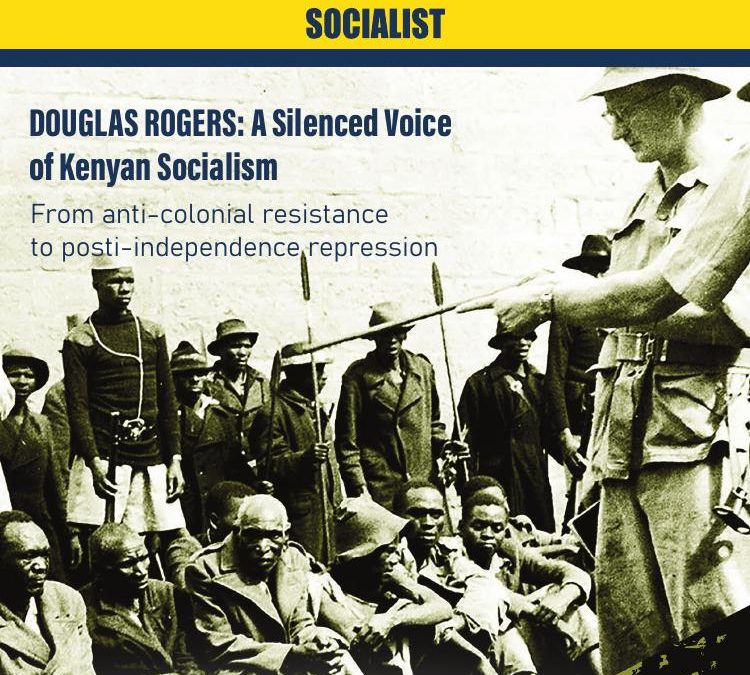
The second article focuses on Douglas Rogers, whose contributions to Kenyan and African anti-colonial struggles remain largely unknown. Through the account by his son, Nick Rogers, we see Rogers’ role as a socialist journalist and advocate of Pan-African unity. His work supported Kenya’s independence while promoting socialism as the path to genuine liberation. In post-independence Kenya, however, radical voices were suppressed, socialist leaders sidelined, and neocolonial structures entrenched. Despite repression and marginalisation, Rogers remained steadfast in exposing injustice and advocating democratic socialism and African unity.
Nicholas Mwangi revisits Frantz Fanon as a crucial guide to understanding Africa’s unfinished liberation. He demonstrates how post-independence ruling classes reproduced neo-colonial domination, undermining genuine sovereignty. While recent developments in the Sahel signal renewed resistance, they also raise important questions about leadership, mass participation, and revolutionary direction. Mwangi calls for the revival of Pan-Africanism as a militant, mass-based project capable of confronting imperialism and advancing a socialist future.
In the fourth article, Sobukwe Shukura reflects on major revolutionary moments in global history, from Haiti’s 1804 liberation, the first successful Pan-African revolution, to Cuba’s 1959 socialist victory. He connects these struggles to Venezuelas Bolivarian Revolution under Chávez and Maduro, highlighting its resilience despite U.S.-led coups, sanctions, and embargoes. He calls for renewed international solidarity with Palestine, the Sahel Alliance, and other anti-imperialist struggles, emphasising the need to defend sovereignty and advance people’s power globally.
Finally, Ukombozi Library’s educational work is highlighted through its free online course launched in late 2025: Introduction to Marxist Economics, with a focus on Kenya. This course is part of a broader programme planned for 2026, aimed at both beginners and those familiar with political economy. Nicholas Mwangi outlines how the course combined theoretical learning with interactive discussions, equipping participants with tools to analyse capitalism, colonial legacies, and contemporary struggles for liberation.
Kimani Waweru