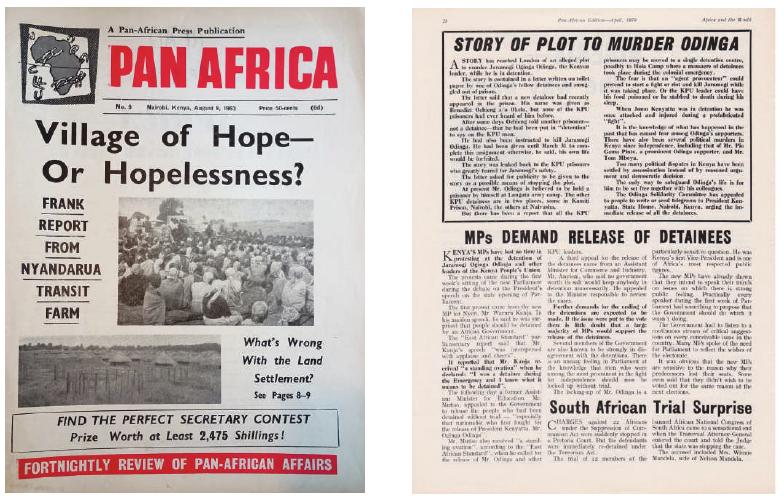
In 1977 when my father, Douglas Rogers, wanted to illustrate how neo-colonialism asserted control over Africa, he turned to the example of Kenya. In a first article, he discussed how the Kenyan economy was controlled by foreign companies in much the same way as had been the case under colonialism.
In a second article, he laid out the political events that blocked any radical change from happening after the Kenyan people achieved independence in 1963 after a brutally tough political struggle. Those events included the capture of the more radical independence party, the Kenya National African Union, by the very politicians who in the pre-independence election had stood against KANU and been backed by the colonial and white settler forces. The left wing of KANU had been isolated and forced out of the party. A few years later, the new socialist party had been banned and its leaders detained.
Two years before writing these articles, the popular socialist politician, Josiah Mwangi Kariuki, who my father counted as a friend, had been tortured and killed in a murder for which no one has ever been prosecuted – one in a string of extrajudicial killings that punctuate Kenya’s political history.
The articles were part of a series entitled “Socialism Simplified”, written by my father for a Ghanaian socialist newsletter published from London.
My father was involved in one way or another with Ghanaian politics from 1956 when he was persuaded by George Padmore to travel to the British colony of the Gold Coast to serve as editorial adviser to the newly established Guinea Press. There my father had worked with Nkrumah and others in the Convention People’s Party as the CPP fought that year’s election campaign and resisted attempts by the opposition to frustrate the transition from self-government to full independence. On March 6, 1957, the Gold Coast became an independent country under the leadership of Nkrumah and, to signify that it was no longer simply a source of raw materials for richer and more powerful countries, renamed itself Ghana.
It is as a collaborator with Nkrumah that, in the historical record (if only in its footnotes), my father is best known. However, he also had a close involvement in the politics of Kenya, and Shiraz Durrani and Kimani Waweru have invited me to write about that aspect of his life for The Kenya Socialist.
I have been reading through my father’s papers. They contain almost all his political journalism, including runs of the newspapers and magazines he edited, extensive correspondence, and a wealth of documents of all sorts. The papers provide the basis for this article,3 in which I will focus on the newspaper my father founded and edited in Nairobi for a year from 1963 to 1964, and another journal he edited from London from 1964 to 1971. This was the pivotal period in Kenya’s history when the orientation of the independent nation’s political economy was set.
British anti-colonialism
Douglas Rogers, who was born in 1919 and died in 2002, made his first connection with Kenya as part of the anticolonial movement in Britain. Rogers was a journalist, joining his local newspaper in Romford to the east of London as a trainee when he was approximately 17 years old. He became assistant editor at the New Leader in late 1944. The New Leader was the weekly newspaper of the Independent Labour Party and the editor Rogers assisted was Fenner Brockway, already a famous opponent of British colonialism and all imperialisms. Brockway was political secretary of the ILP as well as editor of its newspaper. When Brockway resigned as editor in 1946, Rogers replaced him in that role and renamed the journal the Socialist Leader.
The New Leader and then the Socialist Leader published articles by many of the principal leaders of the independence struggle in Africa. The Trinidadian anti-imperialist, George Padmore, was a frequent contributor and he was a member of the editorial committee of the ILP’s theoretical journal, Left, on which Rogers also served.
Rogers credited Fenner Brockway and George Padmore with setting the course of his life. Rogers was involved with all the various iterations of the post-war British anticolonial movement. Successively, secretary of the British Centre Against Imperialism (1947 to 1948); press officer and then secretary (1952 to 1954) of the British Office of the Congress of Peoples Against Imperialism (that was headquartered in Paris); and a founder and the first general secretary of the Movement for Colonial Freedom (from 1954). When he returned to London in 1958, after two years in Accra, Rogers edited the MCF’s monthly journal. Fenner Brockway chaired all these organisations, and George Padmore was closely involved.
A major focus of the British anti-colonial movements’ campaigning was Kenya’s struggle against white settler colonialism. Rogers met Mbiyu Koinange and Achieng’ Oneko when they travelled to London in 1952 with the Kenya land petition that advocated an end to the racist distribution of land and economic resources in Kenya. After the declaration of the State of Emergency in Kenya in October 1952, Koinange stayed in Britain and was an important speaker and campaigner for first COPAI and then the MCF. Oneko returned to be imprisoned until 1961 by the British colonial authorities — tried at Kapenguria, he was acquitted on appeal but remained in detention anyway.
In 1953, the secretary of the now-banned Kenya African Union, Joseph Murumbi, arrived in London having escaped incarceration in Kenya by the skin of his teeth.
It is an odd quirk of British colonialism (that did not apply in a more repressive France) that activists who could be thrown into prison by order of the governor in the British colony where they were born could escape that fate simply by turning up in the heart of the colonial power. The same principle applied to books and newspapers. Many of the publications of COPAI and the MCF (and George Padmore’s books), distributed in Britain without restriction, were banned in Britain’s colonies and anyone in possession of them subject to prosecution and potentially imprisonment.
George Padmore quite correctly characterised the political arrangements in many of the colonies, regardless of the nature of the domestic politics of the colonial power (and in Britain, regardless of whether the Conservatives or Labour Party were in office), as “colonial fascism”.
Rogers worked closely with both Koinange and Murumbi. Murumbi was appointed assistant general secretary of the MCF. To help the organisation stay financially afloat, Murumbi and Rogers agreed to share a single salary. They met all the leaders of the independence struggles who travelled to London. The MCF helped to organise their visits, providing a political platform, as well as leading the campaign to convince British public opinion (and especially the members of the Labour Party and the trade unions) to oppose colonialism.
It was at this time that Rogers met a young Tom Mboya when the latter came to Britain to attend a course at Ruskin College, Oxford.
Pan Africa
In August 1962, Douglas Rogers travelled with his family, including an almost two-year-old me, to Nairobi at his own expense to offer his services to the Kenya African
National Union (KANU) — the party Rogers considered to be leading the struggle for independence. Contrary to what some people have conjectured, Rogers travelled without Nkrumah’s blessing or even knowledge. He was in no sense “an agent of Nkrumah”.
Rogers was taken on at Pan-African Press, whose management board was composed of leading KANU luminaries. It was the only African publishing venture in a national newspaper environment that was dominated by the foreign-owned Nation and East African Standard groups. It was already publishing a Swahili-language newspaper, Sauti ya Mwafrika, and the Nyanza Times was to join its stable. Rogers planned, designed and managed the launch in April 1963 of an English-language fortnightly, Pan Africa. He was the editor for most of the following year.
In Kenya (as earlier in Ghana), Rogers identified himself wholly with the African struggle. He did not lead the life of a British expatriate. He and his family lived in a mixed Asian and African neighbourhood of Nairobi where there were no other Europeans. All his work colleagues and most of his friends were Africans and Asians.
During a rally in Nairobi addressed by Kenyatta, it was announced that KANU was to open membership to all races. Rogers was brought up onto the platform and welcomed as the first European member of KANU. My mother was the first European woman member.
Rogers lived on a modest salary. When Pan Africa engaged in a critique of the different racially based salary scales that operated for journalists on The Nation newspaper, that newspaper’s editor assumed that Rogers must also be on a “European” salary. Pan Africa was able to reply: “The editor of Pan Africa (the only European employed by Pan-Africa Press Limited) was recruited locally, on local terms and on the same salary scale as other employees doing comparable work. Such things are possible, you know!”
Looking through the 24 issues that Rogers edited, I am struck by how lively Pan Africa was.
The main concern of the first few issues was the forthcoming elections – for regional assemblies, the House of Representatives, and the Senate that were spread over more than a week in May.
Even before the launch of Pan Africa, Rogers was worried that Pan-African Press would not be able to play a full part in the KANU campaign: “I found that at the Press we were unable to meet the requirements of the campaign because of a shortage of type whereas the opposition to KANU had plenty of funds and resources from colonialist sources which we were physically unable to match.
“I had worked in Ghana and knew that at their Guinea Press they had a Monotype Super-Caster which could quickly provide what we needed. I made the suggestion to our general manager, Joseph Murumbi, who immediately contacted Jomo Kenyatta. Kenyatta wrote to Nkrumah, and I wrote specifying exactly what we needed and how it could be provided.
“Nkrumah’s response was typical. He told Guinea Press to cast the types I had requested and shipped them in cases by the next plane.
“Those types allowed us, by working 24 hours a day, to mount a tremendous campaign which helped substantially in winning the election and bringing about independence under the KANU banner.”
The next challenge facing KANU was to fashion a path to independence that avoided opposition threats to tear the country apart – the struggle between KADU’s regional majimboism and the creation of a Kenyan ‘nation’. The constitution imposed by the British gave regional assemblies wide-ranging powers that potentially could frustrate a national government intent on carrying through radical changes.
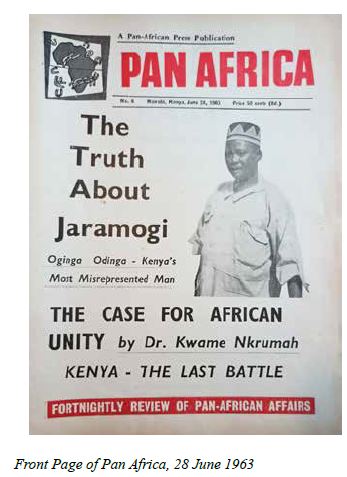
Even worse, some of the KADU-controlled regions, which proceeded to elect their very own ‘presidents’, began to talk in terms of creating autonomous regional states and even succession. An editorial in Pan Africa characterised Ronald Ngala, president of both KADU and the Coast Region as ‘the Tshombe of Kenya’ (“Kenya – The Last Battle”, Pan Africa, 28 June 1963).
The Congo was not the only relevant parallel. The opposition to Nkrumah had played exactly the same card in Ghana prior to independence, threatening the succession of the Ashanti region. Rogers had witnessed the violent consequences on a trip to Kumasi, the Ashanti capital, during the 1956 election campaign when several supporters of the CPP had been killed.
Rogers, in Pan Africa, repeatedly called the Kenyan succession threats ‘subversion’. For instance, when Daniel arap Moi, president of the Rift Valley regional assembly, declared at a rally in Nakuru, “We want complete autonomy for the Rift Valley Region,” an editorial in Pan Africa was headlined, “Invitation to Civil War – while the Prime Minister rallies the nation, the KADU leaders preach sedition” (Pan Africa, 26 July 1963).
Ultimately, it was the process that brought successive tranches of opposition party leaders (from Paul Ngei’s African People’s Party, to whom Pan Africa made a direct appeal, as well as KADU) into KANU that averted the threat to Kenya’s unity. It was a process that changed the political balance of forces within KANU and arguably changed its character. That, however, would only become clear after independence.
Socialism
In the meantime, Pan Africa‘s editorial line made the assumption that a KANU government was committed to a thorough-going “social revolution” that would rid Kenya of all vestiges of colonialism and set the country on a path to socialism.
Pan Africa, under the editorship of Rogers, carried a large number of articles discussing socialism and how it could be achieved in the circumstances of Kenya and Africa. There was a seven-part series by Wanguhu Ng’ang’a (Pan Africa, 12 July 1963 to 18 October 1963). Burudi Nabwera, later to become a stalwart of President Moi’s regime, wrote several hard-hitting articles advocating socialism.
Rogers emphasised in editorials and other articles that socialism meant the social ownership under democratic ownership and control of all the productive forces – even if the road to such a society in countries like Kenya, lacking much in the way of productive forces, was not straightforward.
The newspaper published articles by planning experts working in other African countries that addressed some of these questions, e.g., the Polish economist, Jan Drewnowski, who was serving as professor of economics at the University of Ghana, and G Karmloff, Economic Adviser to the Ministry of Development Planning, Tanganyika.
Rogers met Oginga Odinga, second-in-command in Kanu, for the first time in Kenya.
In a profile of Kenyatta’s first cabinet, appointed in June 1963, in which Odinga was named Minister of Home Affairs, Rogers suggested that the economic planning portfolio should be removed from Finance Minister James Gichuru and assigned to Odinga, who should chair a council of economic planning, with the remit to coordinate the work of other relevant ministries (Pan Africa, 14 June 1963).
As a mainly agricultural country with a background of fierce colonial-era struggle over the land, no sector of Kenya’s economy was more important than agriculture. Pan Africa in its first year devoted many articles to the topic.
Rogers accompanied JM Kariuki and GG Kariuki, the local MPs, to visit a transit centre and a land settlement. The transit centre housed Kikuyu families who had been expelled from the Rift Valley as a consequence of the ethnic instability created by the campaign for majimbo (a foretaste of the future violence that was to periodically disfigure Kenyan politics). The land settlement, after an initially very slow reallocation of bought-out European farms, was providing inadequate seven-acre plots of land for landless families. The conditions at both locations were pretty miserable although the two MPs, especially JM Kariuki, were able to inject an element of hope, at least for that day, into the residents’ lives.
Rogers, in the article, laid out an alternative approach to breaking up large commercial farms and sharing out the acreage on an individual basis. He advocated cooperative farming, with the state providing technical support. Alongside the cooperative farms, related processing industries could be established, as well as schools, medical centres and other social facilities. It was a vision of a coordinated approach that could provide prosperous and meaningful lives for people living in rural areas.
Rogers had worked on a very similar policy prescription with Joseph Murumbi in London (sometime during 1958 to 1959) – a proposal for an experimental, multi-racial, cooperative agricultural venture. And a little while after Rogers’ article appeared, Joseph Murumbi, as Minister of State in the Prime Minister’s office, also wrote, arguing against a return to subsistence farming. Cooperative farming would allow large economic units to be maintained and provide a basis for socialist community development.
Anti-colonialism
The fight against colonialism and white supremacy across the whole of Africa occupied many column inches in Pan Africa. The Central African Federation, which had trapped the large African majority of what is now Zambia, Malawi and Zimbabwe in a political structure that ensured white supremacy in perpetuity, and had been a target of the anti-colonial movement in the 1950s, was disintegrating. Northern Rhodesia and Nyasaland were heading towards independence on a democratic basis. Southern Rhodesia remained under the control of its white minority (fewer than a quarter of a million Europeans dominated 3.7 million Africans) and was being handed the bulk of the shared resources, including the military hardware, of the federation.
Elsewhere the armed resistance by the liberation organisations in the Portuguese colonies was picking up pace. Pan Africa covered all of this (including publishing a two-part series by Kwame Nkrumah on Portuguese colonialism). But it was South Africa and its repressive apartheid system that received most coverage. Fenner Brockway, a frequent contributor to the journal, attacked the British government’s collaboration with South Africa – selling military equipment to the regime and making life difficult for opponents of apartheid who managed to escape to the adjacent British “protectorates” (Swaziland, Basutoland and Bechuanaland, as they were then called).
KANU’s electoral programme promised that it would ban all South African imports. Rogers reported on retailers who were still stocking South African goods. He advocated that the government go beyond its original commitment and announce a date from which the sale of South African products would be prohibited.
Pan Africa launched a ‘buy local’ campaign in which Rogers reported on small and medium-sized Kenyan producers of the kind of consumer goods that South Africa supplied to Kenya.
One of the most difficult struggles for independence in Britain’s African empire had been in Kenya. Pan Africa resisted calls in the supposed interests of ‘reconciliation’ to draw a veil over the cruel repression of the Emergency — the term “colonial fascism” barely does justice to the killings, the torture and large-scale detentions and confinement to concentration camps of so many. In 1963 JM Kariuki published his memoir, Mau Mau Detainee. Kariuki admitted to joining the Mau Mau and serving as part of its urban support network. Rogers welcomed and reviewed the book in the third issue of Pan Africa.
Later the bumper independence ‘souvenir’ issue of Pan Africa provided a comprehensive survey of the depredations of colonialism and the courage of those who fought for freedom. Pio Pinto provided one long article and Rogers wrote two others. Rogers assessed the declaration of the Emergency to be a political scam that had aimed to suppress non-violent forms of African political expression. The scale of the repression by British forces had left many Kikuyu men with little option but to escape to the forests. Rogers judged the actions of the Mau Mau fighters to be no different to the partisans fighting German occupation during the Second World War who were lauded as heroes. The Mau Mau should occupy a similar place of honour in independent Kenya. The articles earned Rogers a postbag of abusive letters from some Kenyan Europeans who accused him of being a traitor to his race.
African Unity
Rogers’ very first editorial in the issue of April 19 was headlined: “Pan Africa states its case: Socialism and African Unity”. Ironically, given the title of the publication, it was Pan Africa’s support for African unity that eventually was to bring Rogers’ editorship to an end.
A few weeks after the launch of Pan Africa, the Organisation of African Unity had been launched at a conference in Addis Ababa in May 1963. The issue of June 28, 1963, carried the text of Kwame Nkrumah’s speech at Addis Ababa (‘The Case for African Unity’). In an accompanying editorial, Rogers stated: “We believe that a united Africa pursuing a socialist policy of using the resources of the continent for the welfare of the people can create during the next few decades a great new civilisation.”
It turned out that not everyone agreed. It was Rogers’ old friend and the ex-general manager of Pan-African Press who led the attack on the idea that African unity was a pressing necessity. In a speech to the Nairobi Rotary Club in October, Joseph Murumbi, who had recently stood in as acting Prime Minister while Kenyatta was abroad, lashed out at the leaders of Uganda (the Prime Minister was Milton Obote) for allegedly offering resistance to East African Federation — they “feel they might become nonentities overnight”. Murumbi suggested that Kenya and Tanzania might proceed to federation without Uganda.
Then, just months after the launch of the OAU, came an attack on the very idea of Pan-African unity: “It may take centuries before this idea of a United States of Africa can be developed.” And, for good measure, Murumbi attacked Nkrumah’s Ghana as a dictatorship.
Rogers responded in the issue of November 1 with an editorial headlined, ‘An Unfortunate Speech’. He criticised Murumbi for making off-the-cuff comments in front of “European-inspired businessman’s organisation” that had damaged relations with its East African neighbour.
On African unity, Rogers said: “If Africa wishes to catch up with the rest of the world and hold its own, it has got to unite. It has got to form a United States of Africa… Mr Murumbi’s pessimism would condemn Africa to centuries of backwardness and second-rate status in the world… To express scepticism about the capacity of African countries to put the interests of United Africa above individual nations is at the same level of political thinking as Mr Ngala expressed in Kenya when he put tribal loyalties before national ones.”
Rogers suggested that Murumbi “should consult his boss, Mr Kenyatta, as to the impetus which resulted from the Fifth Pan-African Congress held in Manchester in 1945 and which triggered off a new epoque of African freedom struggle.”
As for the attack on Nkrumah, it was “the sort of trite, superficial observation one expects from imperialist newspapers, not from an African Minister.” In the next issue, Pan Africa published a strongly worded letter from Ghana’s High Commissioner in Nairobi.
Behind the scenes, Rogers came under increasing criticism for authoring and publishing an attack on a KANU minister (although the first issue of Pan Africa had explicitly said the journal would not refrain from doing so). Furthermore, he came under pressure to deprioritise African unity and publish more on East African Federation.
Rogers pointed out that he could only publish the material that he was sent and that there had in fact been plenty of coverage of the negotiations over regional federation, but that, in his view, federation should not be used as an excuse to undermine the drive to African unity. In fact, in correspondence with Nkrumah, he was advising the Ghanaian President that opposition to regional groupings (Nkrumah’s inclination) would make no headway in East Africa. In the issue of December 27, Rogers doubled down on this analysis: “Pan-Africanism means more, much more, than East African Federation. Federation of the East African countries is a logical outcome of the links which already exist through the Common Services Organisation and in other ways, but it will have little real political and economic meaning unless it is integrated in a total African Union…
“A Pan-African Union, however, which controls the whole vast economic resources of Africa – and the vast consumer market of Africa – would be in a position to bargain in the hard terms of twentieth-century business with those powers who will not respect the right of independent states to follow the economic and political policies they feel most appropriate for themselves.”
The end came in February 1964 when Rogers was presented with an ultimatum to present the content of each issue of Pan Africa to a board meeting that would approve, or not, each article. His position as an independent editor was no longer tenable and he submitted his resignation with one month’s notice, editing his last issue in March.
Odinga, who was part of the management structure of Pan Africa, tried to dissuade Rogers from resigning.
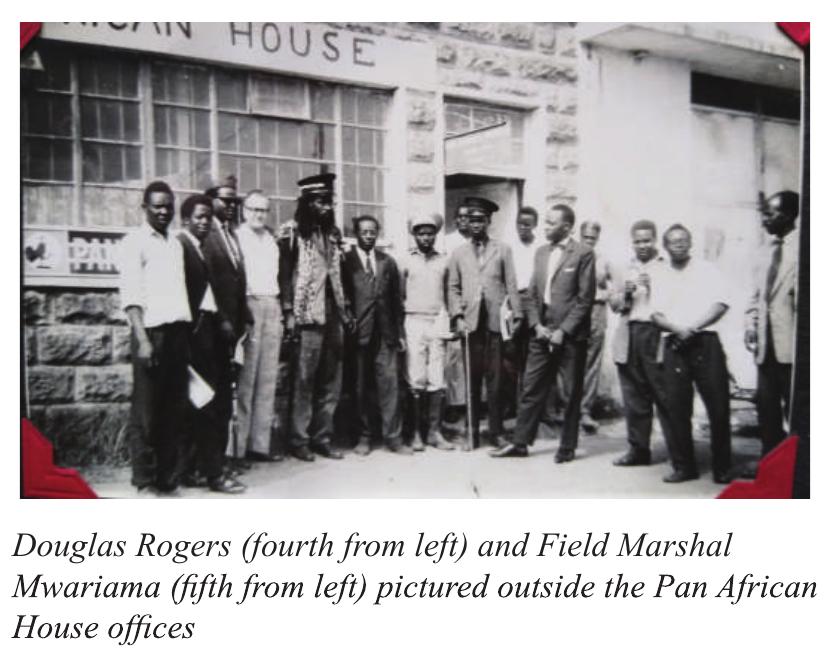
Rogers also warned Odinga that the Government was ‘falling into neo-colonialist errors’: “In the last couple of weeks we have seen the military agreement between the Kenya and the British Governments which I consider totally inconsistent with Pan-African principles, socialism and non-alignment; we have seen the imprisonment of the freedom-fighter, Field-Marshall Mwariama, which to my mind indicates that the old colonialists in the police and magistracy now feel free to make a come-back; and now we have the unpleasant spectacle of the ex-colonial police chief, with the backing of the African Government, leading a campaign to evict African peasant farmers from European settler farms, large tracts of which… are uncultivated… When such things happened under the colonial government, every African nationalist rose in protest. Now we find Mzee Kenyatta’s Government doing the same thing.”
Africa and the World
Rogers’ voice was not long stilled. In October, with the support of Nkrumah, he launched a new magazine from London with an office in Fleet Street. It was called Africa and the World, came out monthly and was distributed all over Africa, the Caribbean, the United
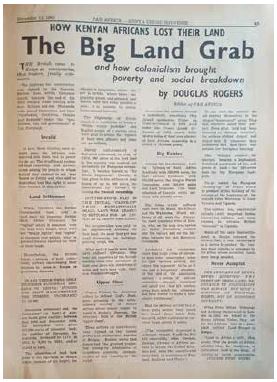
Pan Africa, 12 December 1963: “The Big Land Grab”
States and in Europe. It continued publication until December 1971, at which point the banning of the magazine in one African country after another had made the retrieval of sales income impossible (even when the magazine entered the country using underground methods).
However, during those seven years, Africa and the World established a fine reputation for forthright comment and an unblinking commitment to the cause of African liberation, socialism and Pan-African unity. The agenda first mapped out in Pan Africa continued.
The magazine engaged with politics in Kenya.
The Kenyan government responded by banning Africa and the World (including “all past and future issues”) and Rogers was declared a “prohibited immigrant” for activities “contrary to the interests of national security”. The ban lasted for a year. The debate in the Kenya parliament on the ban was a contributory factor to the split from KANU by Odinga and other left-wingers to form the Kenya Peoples’ Union (KPU).
Rogers thought the split had been premature and that the left should have carried on the fight within KANU for longer. He was concerned by the lack of support for the KPU among Kikuyu people, evidenced by the heavy defeat suffered by Bildad Kaggia in the 1966 by-elections that government forced KPU MPs to fight. However, Rogers reported developments in the pages of Africa and the World and carried articles by KPU politicians. As the repression of the KPU became more severe, organisers were imprisoned for unlicensed meetings (licences were a colonial-era requirement).
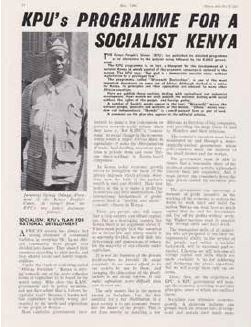
Africa and the World, Issue 47 (May 1969): KPU
Programme for a Socialist Kenya
Bildad Kaggia was imprisoned for six months on entirely spurious grounds. Even school children were sentenced (usually by European magistrates) for the possession of ‘illicit’ political material (see “The Persecution of KPU”, Africa and the World, May 1968). Rogers’ magazine entered full campaign mode. When the KPU was blocked from printing its Wananchi Declaration in Kenya, Rogers arranged for it to be printed in London and published the text over two issues in Africa and the World (May and June 1969).
With the banning of the KPU and the detention of its leaders in October 1969, Africa and the World took on the role of an organising centre for opposition to the Kenyan Government. At the beginning of 1970, for a second time the magazine was banned, and Rogers proscribed.
Rogers made his Fleet Street office available to Kenyans in London to organise an Odinga Solidarity Campaign, and a Kenya Socialist Group, helping the latter organisation produce three issues of a newspaper in Swahili and English called Sauti ya Wananchi (Voice of the People).
When a report was received of a plot to assassinate Odinga while he was in detention, Rogers arranged for a letter, exposing the risk to Odinga’s life, to be sent to every MP in Kenya.
Although banned in the country, Africa and the World retained the ability to stir dissent even among KANU MPs. An article in the magazine exposing phoney accusations about foreign money made against a still-detained Odinga was raised in parliament (see “Storm Over ‘Africa and the World’ Article”, Africa and the World, June 1970).
In 1971 Odinga was released. The front-page of the May 1971 issue of Africa and the World published ‘The Picture That Shocked Kenya!’, showing an emaciated and grizzled Odinga who, throughout his detention, had been kept in solitary confinement and denied access to reading or writing material. An article discussed ‘The Cruelty of Kenyatta’. Indeed, those who had stood beside Kenyatta at Kapenguria (like Oneko and Kaggia), or who, like Odinga, had refused to take any official office until Kenyatta was released from his own detention in 1961, seemed to suffer disproportionately from the regime’s repression.
Kenya Socialist Party
Achieng’ Oneko remained detained until 1975. Africa and the World published its last issue in December 1971. Rogers continued to correspond with Oginga Odinga until Odinga’s death in 1994. In the 1970s, he orchestrated letter writing campaigns by various politicians from around the world on behalf of those imprisoned in Kenya. He organised parallel campaigns for his comrades in Ghana where the military regime was trying civilian politicians and sentencing them to death for alleged sedition.
For a period after Kenyatta’s death in 1978 and the accession of Daniel arap Moi, there were hopes for a political liberalisation in Kenya. Odinga hoped to stand for a parliamentary seat in Nyanza, but at the last minute, he was blocked.
From the end of 1981, Odinga was looking to launch a new socialist party. The constitution still allowed for multi-party politics even though KANU was the only legal party. The strategy, which Odinga discussed with Rogers, was to secure international support before announcing the bid to secure registration in Kenya for a Kenya Socialist Party. Rogers coordinated plans with Odinga, Fenner Brockway, British MPs Stan Newens and Joan Lester, and Liberation, the successor organisation to the Movement for Colonial Freedom.
On a visit to London in May 1982, Odinga, accompanied by Rogers and Brockway, met with Labour leader Michael Foot and Bernt Carlsson, General Secretary of the Socialist International to which the new party hoped to affiliate.
However, news of Odinga’s plans leaked and in June 1982 the constitution of Kenya was amended (adding the infamous Section 2A) to make the country a de jure one-party state. The failed air force coup attempt of August 1, 1982 opened the most repressive period in
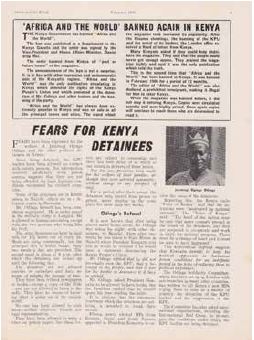
Africa and the World, Issue 56 (February 1970): “Africa
and the World” Banned Again in Kenya
Kenya’s history. Odinga was placed under house arrest and his son, Raila, detained without charge for most of the period until June 1991 (being released twice only to be rearrested).
Today Kenya enjoys a multi-party political system, but its society remains bedevilled by the consequences of the choices its leaders made in the 1960s and later. A highly unequal society, with many of its people languishing in poverty provides little reward for 60 years of independence and the hard struggle that preceded it.
In 1982, Rogers drew up, at Odinga’s request, a programmatic document that would have formed the basis of a new Wananchi Declaration if the Kenya Socialist Party had ever got off the ground. I close this article with a paragraph from that document.
“The ultimate objective of socialism is that all the means of production, distribution and exchange should be brought into common ownership, under democratic control, and be administered solely to satisfy human need. Socialism assumes that all men, women and children throughout the world have an equal right to a fair share of the bounty of the earth and everything that human ingenuity can provide.”
March 24, 2026
1. ‘How the International Monopolies Dominate the Third World’, The Dawn, October 1977
2. ‘The Intrigues of International Capitalism’, The Dawn, November 1977
3. Thanks are also due to Ismay Milford and Wairimu Gathimba, whose skill and generosity have helped me remotely navigate the extraordinarily valuable material in the Murumbi Africana Collection of the Kenya National Archives.
4. See June Milne, ‘A Great Friend of Africa is Gone’, New African, January 2003; and Opoku Agyeman (1992), ‘Nkrumah’s Ghana and East Africa’, pp 73-77.
5. Earlier in 1962 Rogers had spent three months in Accra, again with his family, invited to launch a magazine for Ghana’s Bureau of African Affairs, which due to inadequate preparation by the Ghanaian authorities, had fallen through. Rogers had left Ghana in frustration and was not in touch with anyone in Ghana at the time he arrived in Nairobi later the same year.
6. ‘Peter Pan replies to Paul Fry’, Pan Africa, 26 July 1963.
7. “New NLC Attack on ‘Africa and the World’ – a reply by the Editor”, Africa and the World, November 1967.
8. Douglas Rogers, ‘Report from Nyandarua transit farm and the Kipi-Wanjohi land settlement – Village of Hope – or Hopelessness’, Pan Africa, 9 August 1963.
9. Joseph Murumbi, ‘Co-operative farms, co-operative villages, mass literacy, youth brigade… These should be part of a national crusade’, Pan Africa, 20 September 1963.
10. See George Bennett, ‘Kenya’s ‘Little General Election’’, The World Today, August 1966, Vol. 22, No. 8, pp. 339-340